
Disclaimer: The views & opinions expressed in this post are my own (which are not directed at any specific entity/party) and do not reflect the views/opinions of any affiliates or employers.
Salam alaiykum everyone,
I hope you are all doing well and in the best of health, physically, mentally, emotionally, and spiritually. It’s been a while since I have written on here, and so far, more than 4 months of second year have started.
How is it?
Not gonna lie, y’all, it’s hard. It’s a different type of hard compared to intern year.
I first started off senioring in clinic, which has not been too bad. I enjoy clinic and I find it quite manageable answering the questions the new interns have. But it was still kind of scary. Because just yesterday, I was the intern. And I have so much to learn. As a senior, the interns would shadow me as I went through my clinic visits, and then I would watch them as they navigated their own clinic panels. That was challenging because I had to balance granting them autonomy while also leading their visits in the right direction. Everyone practices medicine differently, so while I wanted to share how I would go through my appointments, I wanted them to feel empowered to do it their own way.
Inpatient was a different beast. I was so scared to senior it and I had every right to feel that way because it was A LOT.
I was on a seniors-only service, aka a service without any interns, and it was pretty brutal ngl. The service is called the PCU, and it’s an intermediate service between the regular inpatient floors and the ICU. This meant that the patients were sick but not too sick to be in the ICU.
Senioring the service was very, very hard. I was responsible for managing my patients, such as placing all of their orders, following lab results and imaging, reaching out to consultants, and running rapid responses on them if and when they decompensated. I also had medical students to teach as well. I had to prepare what I had to tell the night team about my patients and what to do in case something happened. I went to some of the codes in the hospital. And on top of that, I had to WRITE NOTES. 😩 It was so different from intern year because I did not have anyone to remind me of what to do, and if things came back. I had to do it on my own. At one point, I had to decide to send some of my patients to the ICU. I remember at some points of the rotation feeling very overwhelmed and scared of the huge responsibility.
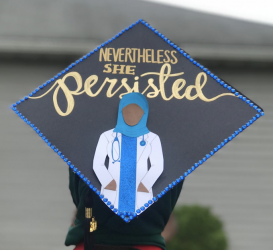
My co-senior was pretty helpful and a 3rd year EM/IM resident, meaning that he had a year of senioring under his belt. It was nice asking him for questions on how to manage my patients. But I also found that I would compare myself to him because he just knew what he was doing. I felt very inadequate some days and felt that I did not belong. It did not help that some days people did not even recognize me as the doctor (because I am a Black Muslim woman, duh), so the imposter syndrome was definitely real.
The days when my co-resident was off were the WORST. I would have to learn his patients and the plans he came up with for them. Then I would have to follow up on my own patients. And then I would have to run the plans with the medical students. And then lead the team and let the attending know the plans. If there were any admissions that came to the floor, I would have to handle that as well. I was set to have four admissions to myself one day 😱😱😱. I remember asking the transfer service to please consider the last admission to someone else, as I was figuring out the first three admissions. I was fighting for my life, y’all! 😭
There were also some days were the senior on our cross-covering service was off. So I therefore had to manage my service while also helping the intern on the other service to make sure they were doing ok.
This service was a lot and then some. One thing that was truly jarring during that time was when my uncle passed away. I was in the middle of placing orders when my sister texted me the news. I thought I would be ok to continue going to work the next day, but I decided…NO. I cannot. I have to value my life outside of medicine. So I took 3 days off to be with my family to mourn my uncle, and then I came back. It was honestly one of the best decisions I could have made for myself during that time, and I am truly glad I did. Please remember that you are a human as well in this process, and to take care of yourself the best way you can.
The days leading up to the end of the service were extremely challenging. I would wake up at 4 am, and there would be days when I would stay until 8 pm. I was not getting enough sleep, and my skin was breaking out. I was so exhausted and over it. I felt like no matter what I did, I was making a mistake or missing something. The feedback I got from my attendings was mixed. They understood it was my first time senioring; however, they kept telling me that I was missing important labs, was too passive with consultants, lacked confidence, and that I needed more time inpatient to get better. Y’all, when I heard that, I was torn into pieces. 😞 But I vowed to keep trying harder and pushing my limits until I improved.
A couple of my close friends from college work at the same hospital I do, and we try to schedule to have lunch together. Usually at these lunches, I look pretty frazzled and overwhelmed, as I am responding to nursing messages, responding to pages, and looking up potential new admissions. One day, as we were discussing our jobs, I started crying. I told them that I did not know what I signed myself up for, truly, and that if it was in God’s timing for me to quit, then I should (lol when I am in the trenches I always think about it 😭). They were genuinely so sweet and told me that I was doing amazing and representing a marginalized group of people. They told me that the finish line was almost near, which it was. Hearing their words was so helpful, and it was the last push of hope I needed to power through the end of the rotation.
Writing about this is bringing out all the emotions I pushed aside after I finished this rotation, but it needs to be said. Training as a physician is not easy. You are working 60-80 hours a week, caring for some of the sickest patients, while neglecting yourself in the process. I never thought that I would be able to do something like this, but through God’s will, anything is possible. However, I definitely do not want to glorify residency. It’s brutal and it sucks. It is scary. It definitely needs to change so that patients and residents get the best care they need.
With all that being said, I am grateful and honored that I got to care for some of the sickest patients during my time in the PCU. Seeing my patients get better and move to the regular floors always made me happy. I enjoyed getting to know them and their families and being apart of their care. While there have been a lot of negatives that residency has given, this has definitely been a huge positive and the motivating factor for me to keep going.
I also enjoyed working with the medical students. I do not want any of them to ever feel as if they are not smart or important enough to be in this field. I always try to place myself in their shoes and try my best to make them feel like they belong.
I am also grateful for my community outside of medicine. I joined a weekly Muslim run club so that I could take my mind off medicine and enjoy nature. I also had the (almost) daily lunches with my college friends, which were so needed. My family has been so supportive, and of course, I have to thank God for all of his blessings and for getting me through the end. Medicine will never make you feel like you are enough, so it’s crucial to have things outside of it that make you whole.
Thank you all so much for continuing to follow me on this journey. If you are struggling, just know you are not alone, and it will get better! I hope this inspires you to keep going and not let anyone or anything deter you from your future goals and aspirations.






 Oumou Fofana
 Oumou's Personal Posts
Leave a comment